Crossing borders, sharing solutions: Twinning activity in the Rhine, Meuse & Scheldt Basin
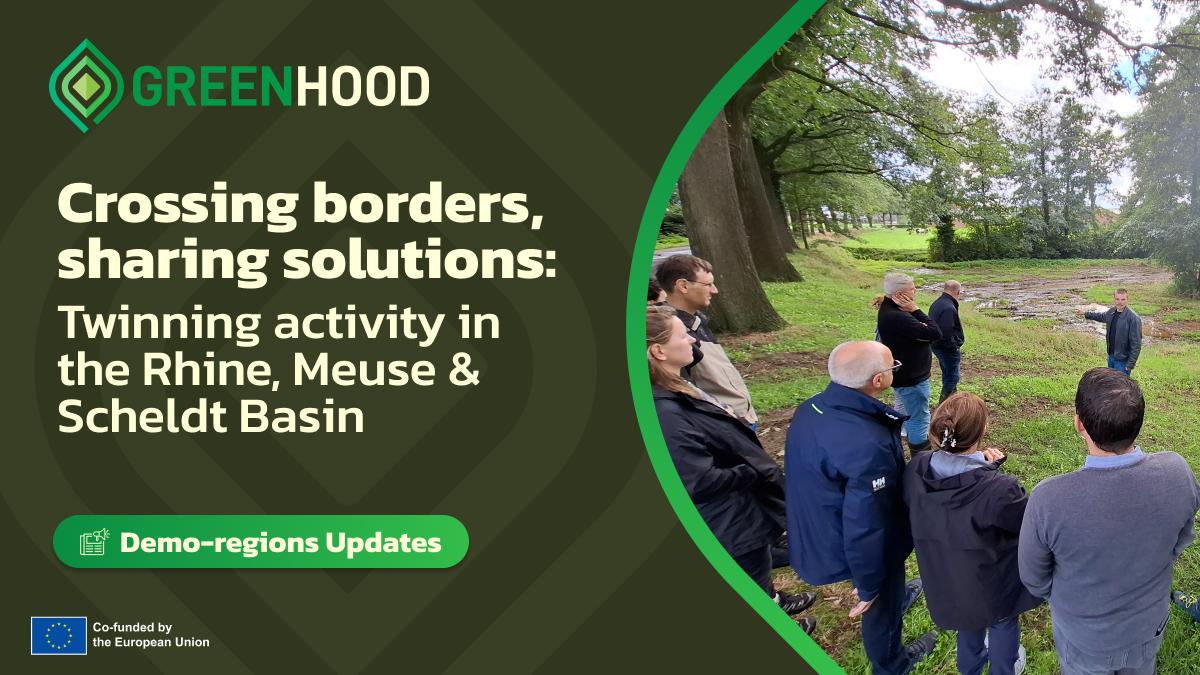
In September 2026, the Rhine, Meuse & Scheldt Basin demo-region hosted its first twinning activity under GREENHOOD's capacity-building programme, welcoming a delegation from Lithuania for a two-day field visit to the demo-sites in the Netherlands.
About the twinning programme
The GREENHOOD twinning programme is a knowledge-transfer mechanism designed to extend the project's results beyond its four demo-regions to other European regions, with a particular focus on Central and Eastern Europe. Through field visits, mentoring, and direct exchange between scientists, policymakers, and practitioners, the programme aims to accelerate the uptake of validated nutrient management practices and support their replication elsewhere in Europe.
Who visited and why?
The visiting delegation came from the Lithuanian LIFE SIP Vanduo project, which is working to address water quality challenges driven by high nutrient inputs from agriculture. Lithuania is preparing to implement the same nature-based solutions being tested in GREENHOOD (woodchip bioreactors and sedimentation ponds) and sought practical insight into how these measures perform under real field conditions.
Participants represented a wide cross-section of Lithuanian institutions, including the State Scientific Research Institute Nature Research Centre, the Nature Heritage Fund, the Environmental Protection Agency, the Environmental Projects Management Agency, Vytautas Magnus University, and the Ministry of Environment.
What took place?
Over two days, which formed the core of the group's wider three-day field programme, partners from Deltares and KWR led visits to two GREENHOOD demo-sites.
At the Vinkenloop catchment (experimental farm Vredepeel), the group visited the woodchip bioreactor and a newly constructed sedimentation pond. At the Vragender Beek catchment, they explored the sedimentation ponds and a multifunctional buffer strip. At both sites, local water board representatives and farmers joined the visit, adding practical, on-the-ground perspectives to the exchange.
GREENHOOD partners shared new measurement results from an artificial flood wave experiment, during which 62% of the mobilised phosphorus was captured in a small sedimentation pond of just 330 m² in the Vragender Beek. Monitoring using the Deltares Aquality App also offered a live demonstration of how residence times influence nitrate removal: one pond with preferential flow showed no nitrate reduction, while a second pond with a higher water level and longer residence times reduced nitrate concentrations from 13 to 6 mg/l nitrate-N.
Discussions covered the design, construction, maintenance, and performance of the solutions, as well as farming practices and monitoring technology, providing the Lithuanian delegation with a comprehensive overview of what it takes to move from concept to implementation.
Looking ahead
This first twinning activity marks the beginning of a structured knowledge-sharing pathway for the Rhine, Meuse & Scheldt demo-region, which will continue through further field visits and online webinars aimed at broadening the reach of GREENHOOD's results across Europe.