From Fish Sludge to Fertiliser: A Governance Roadmap for Trøndelag
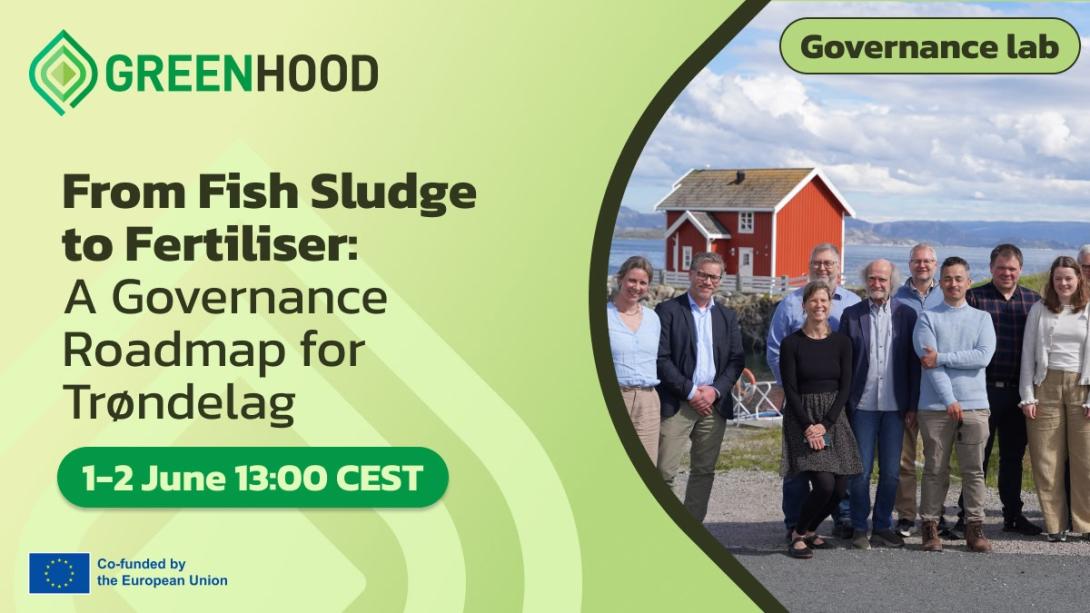
On 1-2 June 2026, GREENHOOD hosted a two-day Governance Lab workshop in Hitra, Norway, bringing together key national and regional actors to explore governance strategies for nutrient recycling in the Trondheim Fjord Basin demo-region. The session united legislative authorities, industry organisations, fish farming companies, biogas developers, agricultural advisors, and researchers in a collaborative effort to map the value chain from fish sludge collection to bio-based fertiliser production.
About the Governance Labs
The GREENHOOD Governance Labs are participatory platforms designed to bridge the gap between technical innovation and policy reality. At each event, we bring together regional stakeholders, experts, and policymakers to co-create actionable roadmaps for sustainable nutrient management.
Our goal is to ensure that the environmental solutions proposed by GREENHOOD are practically feasible, scalable, and perfectly aligned with the regulatory frameworks of our chosen ecosystems. This session focused on the Trondheim Fjord Basin demo-region.
About the workshop
This two-day workshop focused on developing a shared understanding of the challenges and opportunities in nutrient recycling, and on building a governance roadmap for the Trondheim Fjord Basin, and Norway more broadly. Participants engaged in dialogue surrounding critical systemic challenges, including:
- Fish sludge as a resource: Mapping current and future production volumes from the aquaculture industry and evaluating collection and treatment scenarios.
- Regulatory frameworks and documentation requirements: Examining new fertiliser regulations at national and EU level, and the implications for processing fish sludge into compliant fertiliser products.
- Bottlenecks in the value chain: Identifying fragmentation of responsibility, conflicting goals, and barriers to scaling biogas production in Norway.
- Nutrient recycling to agriculture: Exploring how biogas digestate and bio-based fertilisers can be brought into use on Norwegian farms, from pilot agreements to full contracts.
Agenda
Day 1 – Monday, 1 June 2026
The first day introduced the GREENHOOD project and presented four scenarios for fish sludge collection and treatment, ranging across current and increased aquaculture production volumes and varying levels of collection ambition. Presentations and discussions set the stage for a shared understanding of the resource base and the regulatory landscape.
Day 2 – Tuesday, 2 June 2026
The second day shifted focus to governance, technology, and finance. Presentations from Mattilsynet, Miljødirektoratet, Norsk Vann, Trøndelag Fylkeskommune, NTNU, and NIBIO were followed by perspectives from across the value chain (fish farmers, biogas operators, industrial park developers, and farmers). The afternoon was dedicated to workshop sessions in which participants identified bottlenecks and fragmentation across governance, technology development, financial instruments, and knowledge systems.
Who attended?
The round-table dialogue brought together a diverse network of cross-sector participants, including representatives from legislative authorities, county municipalities, industry organisations, fish farming companies, biogas companies, biogas and industrial park developers, agricultural advisory services, and research and innovation organisations. A total of 54 participants took part across both days, with 16 joining online.
Partners
The session was organised by the GREENHOOD project partners in Trøndelag, including NTNU, NORSØK, and Agritech Cluster, in cooperation with a wide network of regional and national stakeholders.