Balancing nutrients in the Ebro livestock-intensive basin
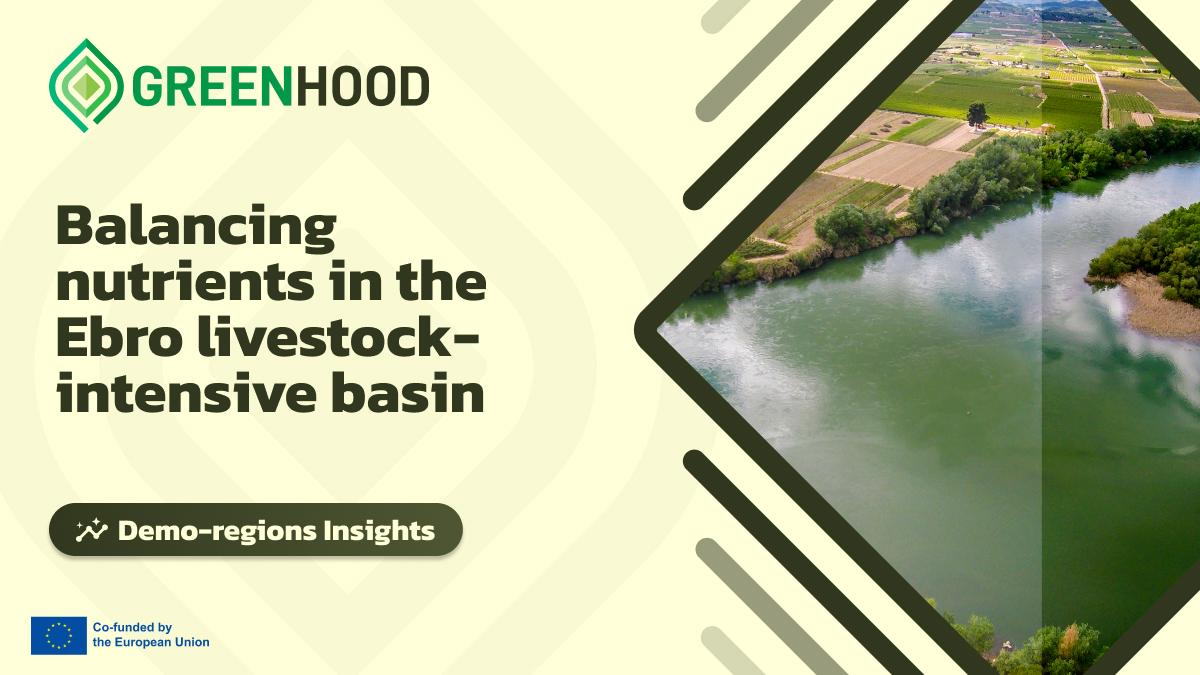
The Ebro River Basin in northeastern Spain is characterised by a semi-arid, irrigation-dependent agriculture. Covering 17% of Spanish territory across nine autonomous communities (mainly Aragón and Catalonia), the basin combines Europe's most concentrated pig production with intensive irrigated cropping. This mix has created a persistent nitrate problem: several aquifers are declared vulnerable to nitrate pollution, some exceeding 150 mg N/L, and roughly a third of Catalonia's territory is designated a Nitrate Vulnerable Zone.
Current status
Agriculture and livestock are the dominant pressure on the basin, driven by high pig, poultry, and cattle densities concentrated in Catalonia and Aragón, combined with intensive irrigation. The basin receives high nitrogen loading from agriculture, with the large majority retained in the system rather than exported - exposing groundwater to contamination and driving ammonia volatilisation.
Nitrogen reaches water mainly through nitrate leaching from over-fertilised and heavily irrigated soils (via winter/spring runoff, percolation from irrigated land, and irrigation return flows), while phosphorus accumulates in soils from decades of manure over-application and is mobilised through runoff and leachate from manure applied to saturated soils.
Because the basin is semi-arid and irrigation-intensive, nutrient losses are closely tied to water management: over-irrigation and inefficient fertilisation (particularly in maize) are key drivers of leaching, with pollution peaking around sowing and in summer.
Current responses
Spain and its regions operate a multi-level governance system: national Royal Decree 47/2022 and the EU Nitrates Directive set the baseline, while the Ebro Hydrographic Confederation (CHE) manages basin-wide water planning, and Catalonia and Aragón each layer on their own regional rules (e.g., Catalonia's Decree 153/2019 on manure, its Bioeconomy and Digestate Strategies).
As for the technological infrastructure, mechanical separation, composting, and anaerobic digestion are broadly implemented for manure, sewage sludge, and organic waste, with emerging pilot-scale efforts in membrane treatment, phosphorus precipitation (struvite recovery), and pyrolysis for biochar.
Regional projects are testing practices such as Living Soil Horticulture (a UVIC-led mulching technique to rebuild soil structure), perennial wheatgrass cropping to reduce nitrate leaching, and biochar-compost amendments.
Where GREENHOOD steps in
GREENHOOD's Ebro work draws on the basin's Spanish partners to build on these existing initiatives, rather than starting from scratch. The project focuses on validating and scaling nutrient-recovery and precision-fertilisation solutions already piloted in the region, while tackling the basin's core governance gap: the policy divergence between Catalonia and Aragón.
To this end, GREENHOOD supports novel governance models - a Multi-Actor Platform, co-governance arrangements, and Multi-Level Governance mechanisms - to harmonise regulation, reduce administrative burden for SMEs, and align local action with EU directives, feeding into the basin's Integrated Nutrient Management Action Plan (INMAP).