Recovering nutrients in Norway's aquaculture-agriculture basin
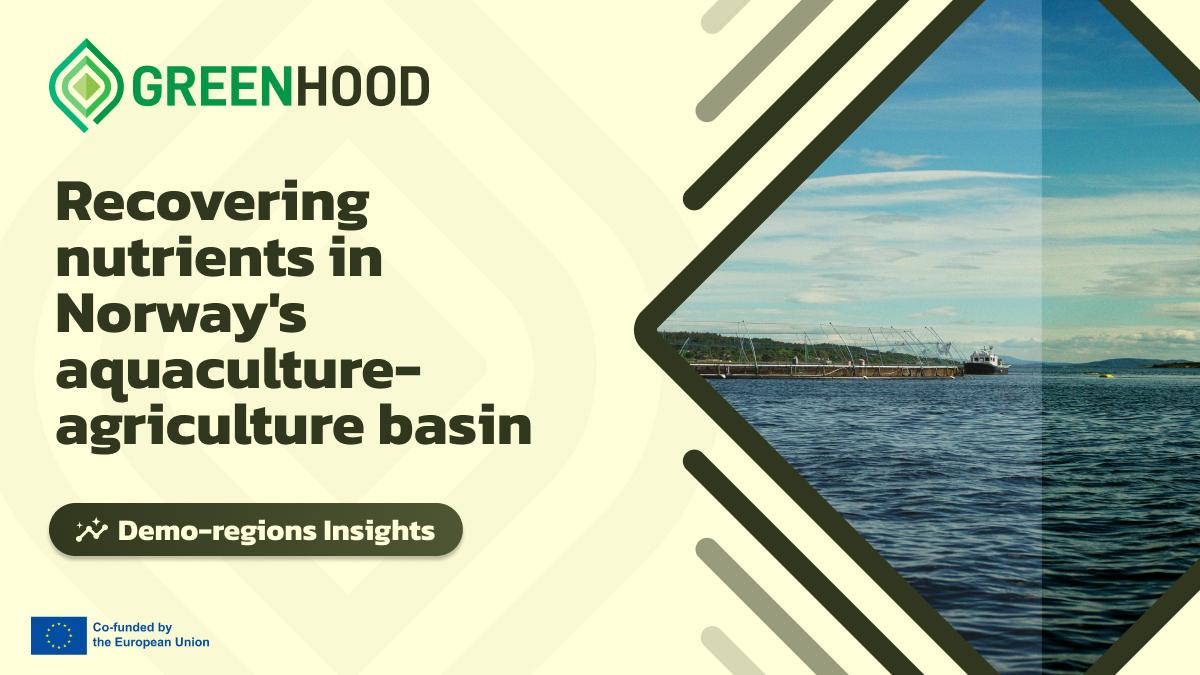
The Trondheim Fjord Basin in central Norway is GREENHOOD's demo-region for the collision between land and sea nutrient flows. Trøndelag county ranks among Norway's top three regions for both agriculture and aquaculture, hosting the third-largest salmon production in the country alongside significant cattle, poultry, and pig farming. This dual land-sea profile has created a distinctive pressure: the inner Trondheimsfjord is a hotspot where high livestock manure surpluses inland meet dense aquaculture along the coast, raising eutrophication risk in sensitive, low-exchange waters such as Botn Lake.
Current status
Aquaculture is the dominant anthropogenic nutrient source in the region, contributing roughly 80% of phosphorus and 55% of nitrogen emissions to coastal waters, mainly through fish faeces and uneaten feed (fish sludge) from open-net salmon pens.
Agriculture contributes a smaller but still meaningful share (about 8% of P emissions), with phosphorus accumulating in soils from manure over-application and nitrogen lost through runoff, leaching, and ammonia volatilisation.
The two sectors are structurally disconnected: fish sludge from the grow-out phase (over 96% of total aquaculture sludge) is barely collected due to low technology readiness and dilution in open water, while manure surpluses concentrate inland around Levanger and Steinkjer, leaving two large, uncoupled nutrient streams instead of one circular system.
Current responses
Norway implements the EU Nitrates and Urban Wastewater Treatment Directives via the EEA Agreement, with the entire country designated a nitrate-sensitive zone, though Trøndelag (unlike the Oslofjord) has no additional regional restrictions. From February 2025, two new national regulations tightened rules on fertiliser production and use, notably cutting the permitted phosphorus application rate in Trøndelag from 35 to 23 kg P/hectare by 2033. Aquaculture is separately regulated through the Aquaculture Act, with a "traffic-light system" adjusting salmon production capacity based on sea-lice levels, though it does not yet account for nutrient pollution.
On the technology side, manure separation and processing are established in agriculture, but aquaculture sludge collection remains at a low TRL, hampered by high water content, dewatering costs, and long transport distances. National research initiatives like BioVerdi, FOSIMO, and the MIND-P project are testing dewatering, stabilisation, and nutrient-recovery pathways, backed by a growing regional innovation ecosystem (NTNU, SINTEF, sector clusters like NCE Aquatech and Agritech Nordic).
Even so, fish sludge isn't yet on the EU's approved fertiliser substrate list, no regulatory framework mandates nutrient recovery from marine pens, and weak value-chain ownership keeps promising sludge-to-fertiliser technologies from scaling commercially.
Where GREENHOOD steps in
In this demo-site, GREENHOOD is exploring transportable high-quality bio-based fertilisers made by combining livestock manure with fish sludge - directly targeting Trøndelag's core problem of two disconnected nutrient streams. The project sits alongside other EU-funded efforts such as AQUAPHOENIX in testing how to make aquaculture's under-used phosphorus and nitrogen commercially viable as a resource rather than a coastal pollutant, while helping close the gap between improving collection technology and the missing regulatory and market pathways needed to actually redistribute those nutrients back to agricultural land.