Green solutions for Dutch ditches: a GREENHOOD Governance Lab
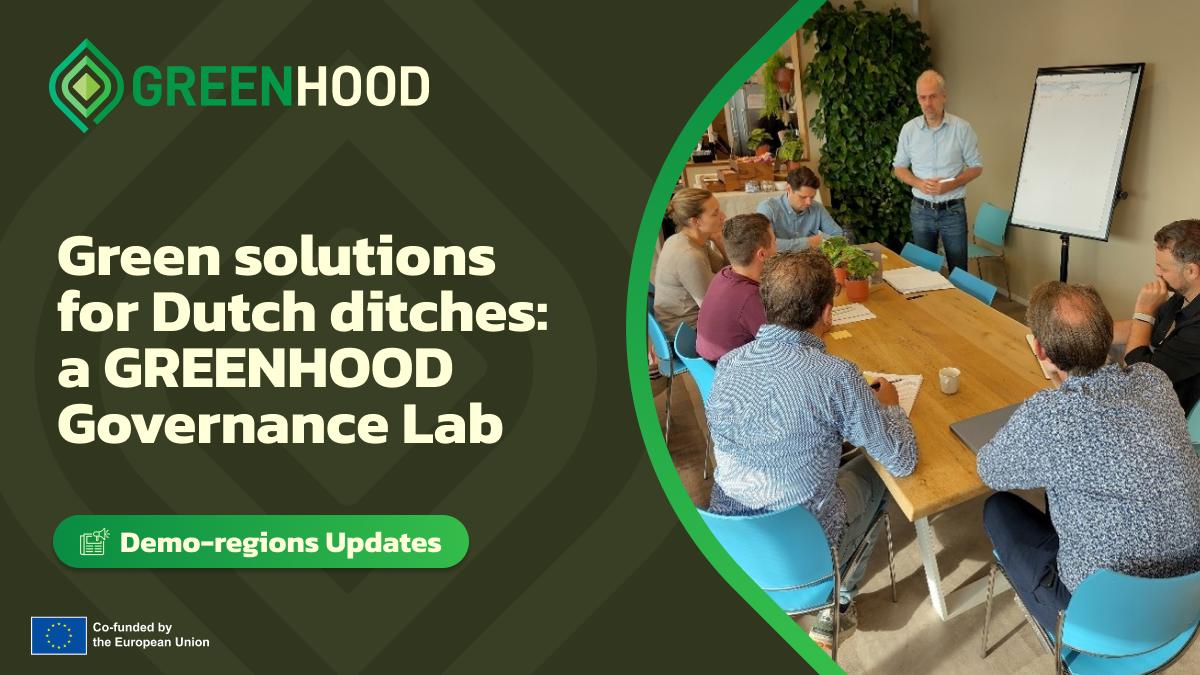
How can nature-based solutions such as woodchip filters, sedimentation ponds, and improved buffer strips move from pilot sites to farms across the Netherlands? On 14 September 2026, Deltares and KWR partners in GREENHOOD’s Rhine, Meuse & Scheldt Basin demo-region, brought farmers, water boards, and other local actors together to find out.
The workshop, Green Solutions for Nutrients in and Around Agricultural Ditches (Groene oplossingen voor nutriënten in en rond landbouwsloten), was part of GREENHOOD’s Governance Labs. These participatory sessions, held across all four demo-regions, aim to turn technical innovation into policy and practice. The Rhine, Meuse & Scheldt Basin joined the series with a session on its Dutch side.
Alongside the Deltares and KWR teams, the session welcomed farmers and farmers’ organisations, water boards, an agricultural nature collective, an agriculture innovation and knowledge hub, a consultancy and innovation agency, and a wastewater and infrastructure engineering company.
From barriers to action
Rather than asking whether these nature-based solutions work, participants examined what holds back their wider adoption. They discussed the practical and organisational conditions required, the main barriers, and the role each party can play in removing them.
Three priorities for scaling up
- A national toolkit of measures: Participants called for an evidence-based toolkit that lets local actors choose measures suited to their context. For each measure, it should spell out the problem addressed, space requirements, suitable locations, costs, expected benefits, the partners and responsibilities involved, available funding, and practical design.
- A water package for the ANLb: The group proposed expanding the existing Dutch Agri-Environment and Climate Scheme (ANLb) with a water package: a national standard, complemented by area-specific additions. This would fit new initiatives into the agreements and funding structures that farmers and authorities already use.
- Shared responsibility: Participants agreed that effective implementation depends on a shared vision of where problems are best tackled and who is responsible for which part of the solution, with governments, farmers, farmer collectives, water authorities, and businesses working closely together.
Building on these outcomes, Deltares and KWR are working to develop the national evidence-based toolkit of measures and to write a policy brief, turning the workshop’s conclusions into recommendations that can support the wider uptake of nature-based solutions for nutrient management.